Build vs. Buy Software: A Decision Framework for Growing Businesses
Every growing business eventually faces this question: should we build custom software tailored to our exact needs, or buy an existing solution and adapt our processes to fit it?
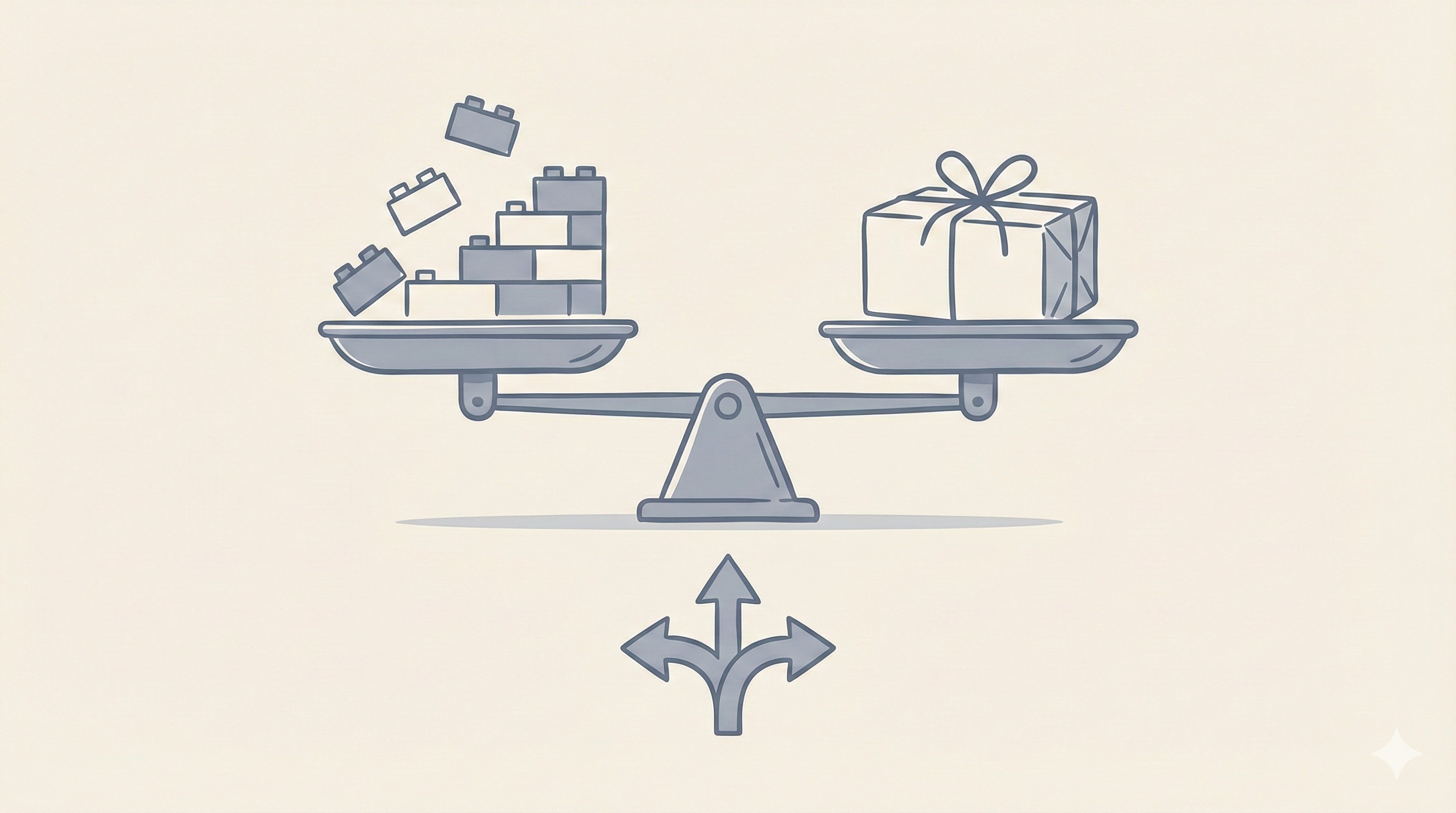
The short answer: It depends on whether your processes are your competitive advantage or just operational necessities.
According to Gartner's 2024 technology spending report, mid-market companies spend an average of 4.3% of revenue on technology. Getting this decision wrong—either way—can waste significant budget and years of operational progress.
Here's a framework for making this decision with confidence.
The Core Question: Is This Process Your Competitive Advantage?
Before evaluating vendors or development costs, answer this:
Does this process differentiate you from competitors?
- If yes → lean toward building custom
- If no → lean toward buying off-the-shelf
Why? Because off-the-shelf software, by definition, is available to everyone—including your competitors. If your order processing works exactly like every other distributor's, that's fine. If your client onboarding is what wins you business, making it identical to competitors is a strategic mistake.
Examples where custom makes sense:
- A distributor's unique delivery routing that competitors can't match
- A clinic's patient experience flow that drives referrals
- A service firm's project methodology that justifies premium pricing
Examples where off-the-shelf wins:
- Basic accounting and invoicing
- Email and calendar management
- Standard HR and payroll processing
The Hidden Costs of Buying (That Vendors Don't Mention)
Off-the-shelf software looks cheap at first glance. Monthly subscriptions seem manageable. But the true cost includes much more:
1. Customization Costs
Most "out of the box" solutions require significant configuration. According to a 2023 Forrester study, the average SaaS implementation costs 2-3x the annual subscription in professional services during the first year.
What this looks like:
- €500/month subscription = €6,000/year
- Implementation and configuration = €15,000-€20,000
- Training and change management = €5,000
- Year 1 real cost: €25,000-€30,000 (not €6,000)
2. Process Adaptation Costs
When software doesn't fit your process, you have two choices: customize the software (expensive) or change your process (disruptive).
The hidden tax:
- Staff workarounds that consume time
- Reduced efficiency from process changes
- Lost competitive advantages you designed into your workflows
3. Integration Costs
Standard software rarely integrates perfectly with your existing tools. Connecting systems requires:
- API development or middleware (€5,000-€20,000)
- Ongoing maintenance as systems update
- Data synchronization management
4. Vendor Lock-in Costs
Once your data and processes live in a vendor's system:
- Migration becomes expensive and risky
- Price increases are hard to resist
- Feature changes are outside your control
- Vendor acquisition or shutdown creates business risk
5. Feature Bloat Tax
You pay for capabilities you don't need. Enterprise software is priced for large organizations with complex requirements. If you use 20% of features, you're subsidizing the other 80%.
The Hidden Costs of Building (That Developers Don't Mention)
Custom software has its own hidden costs that optimistic project plans often overlook:
1. Specification Costs
Before writing code, someone must define exactly what to build. This discovery phase typically costs 10-15% of total project budget—and skipping it is the #1 cause of project failure.
2. Scope Creep Costs
According to the Project Management Institute, 52% of software projects experience scope creep. "While we're at it, can we also..." adds 20-50% to most custom projects.
3. Maintenance Costs
Software is never "done." Budget 15-20% of initial development cost annually for:
- Bug fixes and security updates
- Adapting to browser/OS changes
- Minor enhancements and adjustments
- Server and infrastructure costs
4. Knowledge Dependency Costs
If one person understands your custom system, you have a critical business risk. Documentation, training, and redundancy add to costs but are essential.
5. Opportunity Costs
Time spent building is time not spent on core business. Custom development typically takes 3-6 months for meaningful systems. During that time, your competitors using off-the-shelf solutions are already operating.
The Decision Matrix: 7 Criteria That Matter
Score each criterion from 1-5, then total your results:
Criterion 1: Process Uniqueness
Score 1: Our processes are standard for our industry
Score 5: Our processes are unique and drive competitive advantage
Why it matters: Unique processes need unique software. Standard processes should use standard solutions.
Criterion 2: Change Frequency
Score 1: Our processes are stable; changes are rare
Score 5: We constantly optimize and evolve our workflows
Why it matters: Frequent process changes are expensive in off-the-shelf systems (reconfiguration) but straightforward in custom systems (modification).
Criterion 3: Integration Requirements
Score 1: This system works standalone
Score 5: Deep integration with multiple existing systems is essential
Why it matters: Integration is where off-the-shelf often fails. APIs exist but rarely do exactly what you need without custom development anyway.
Criterion 4: Scale Expectations
Score 1: Our scale will remain stable
Score 5: We expect 3-5x growth in volume/complexity within 3 years
Why it matters: Off-the-shelf pricing scales with usage (you pay more as you grow). Custom systems have fixed costs regardless of scale.
Criterion 5: Available Budget
Score 1: Minimal upfront budget available
Score 5: Can invest significantly upfront for long-term savings
Why it matters: Custom requires upfront investment; off-the-shelf spreads costs over time (but often costs more total over 3-5 years).
Criterion 6: Time Pressure
Score 1: Need a solution operational within weeks
Score 5: Can wait 3-6 months for the right solution
Why it matters: Custom takes time. If you need something tomorrow, off-the-shelf is your only option.
Criterion 7: Internal Technical Capability
Score 1: No technical staff; fully dependent on external support
Score 5: Strong internal team can maintain and enhance systems
Why it matters: Custom systems need ongoing technical attention. Without internal capability, you're dependent on expensive external support.
Scoring Interpretation
Total 7-15: Off-the-shelf is likely your best path. Focus on finding the best-fit solution and budget for implementation services.
Total 16-25: Hybrid approach may work best. Buy a flexible platform and customize it, or buy for some needs and build for differentiating processes.
Total 26-35: Custom development likely provides better long-term value. Invest in proper discovery and partner selection.
The Hybrid Approach: Often the Best Answer
For most mid-market businesses, the answer isn't purely build or buy—it's strategic combination:
Buy for:
- Accounting and financial management (QuickBooks, Xero, Holded)
- Email and communication (Google Workspace, Microsoft 365)
- Basic CRM (HubSpot, Pipedrive)
- Standard HR functions (Factorial, Personio)
Build for:
- Customer-facing portals and experiences
- Operational workflows unique to your business
- Integrations connecting your bought systems
- Dashboards and reporting specific to your KPIs
The Integration Layer
Often, the highest-value custom development isn't a complete system—it's the layer that connects your off-the-shelf tools and adds your unique business logic.
Example: A distribution company uses:
- Standard accounting software (bought)
- Standard warehouse management (bought)
- Custom order processing that integrates both, adds their unique routing logic, and provides a customer portal (built)
Total investment: €40,000 custom development
Annual savings vs. full custom or awkward off-the-shelf: €25,000+
Real-World Decision Examples
Example 1: The Distributor's Order System
Situation: €8M revenue distributor processing 200 orders/day through email and phone calls.
Option A (Buy): Implement standard order management system
- Cost: €1,200/month + €25,000 implementation = €39,400 Year 1
- Problem: Doesn't integrate with their WhatsApp-based customer communication
- Adaptation required: Customers must change ordering behavior
Option B (Build): Custom order system with WhatsApp integration
- Cost: €45,000 development + €8,000/year maintenance
- Benefit: Customers order exactly as they do today; orders process automatically
- Timeline: 10 weeks to deployment
Decision: Build. The competitive advantage of meeting customers where they are (WhatsApp) justified the investment. ROI achieved in 8 months.
Example 2: The Consulting Firm's Project Management
Situation: 25-person consulting firm tracking projects, time, and client deliverables.
Option A (Buy): Implement Monday.com or Asana with professional services
- Cost: €600/month + €15,000 setup = €22,200 Year 1
- Benefit: Proven platform, immediate availability
- Limitation: Generic; doesn't match their methodology perfectly
Option B (Build): Custom project and time tracking system
- Cost: €60,000+ development
- Timeline: 4-6 months
Decision: Buy and adapt. Their project methodology, while good, wasn't so unique that it justified 3x the cost and 6 months delay. They adapted some internal processes to match the software—a reasonable trade-off.
Example 3: The Clinic's Patient Journey
Situation: Multi-location aesthetic clinic with unique consultation and follow-up process that drives their premium positioning.
Option A (Buy): Standard clinic management software
- Cost: €800/month + €20,000 implementation
- Problem: Forces their differentiating patient experience into a generic flow
Option B (Build): Custom patient journey system integrated with their booking and medical records
- Cost: €55,000 development + €10,000/year maintenance
- Benefit: Patient experience remains their competitive moat
Decision: Build. Their patient journey is their product. Commoditizing it would undermine their market position and pricing power.
Key Takeaways
- The build vs. buy decision hinges on whether the process is competitively differentiating
- Off-the-shelf true costs are typically 3-5x the visible subscription price
- Custom development requires 15-20% annual maintenance budget
- Most businesses benefit from a hybrid approach: buy standard, build differentiating
- Score your specific situation against the 7 criteria before deciding
- The integration layer is often the highest-value custom development
Next Steps
Not sure whether to build or buy for your specific situation? We help businesses evaluate their options and make technology decisions that support long-term growth—not just short-term convenience.
Ready to make the right technology decision?
Get expert guidance on your build vs. buy decision with a free consultation.
Schedule Free ConsultationAbout Alcara Tech: We help mid-market businesses build custom operations technology that scales with their growth. Our focus is on creating systems that give you a competitive edge—not generic solutions that make you look like everyone else.